
Before diving into this technical topic, let’s start with how an ignition coil works.
1. How an Ignition Coil Works
An ignition coil consists of a primary coil, a secondary coil, a magnetic core, a switching transistor, and other auxiliary components. During operation, the primary coil is charged by the battery, the secondary coil discharges to fire the spark plug, and the transistor handles switching. Charging time is controlled by battery voltage and engine speed to ensure consistent charging energy each time.
Simply put, an ignition coil is a transformer that steps up voltage from a few dozen volts to tens of thousands of volts. The only difference is that the voltage input to the primary coil is provided by an electronic ignition system.
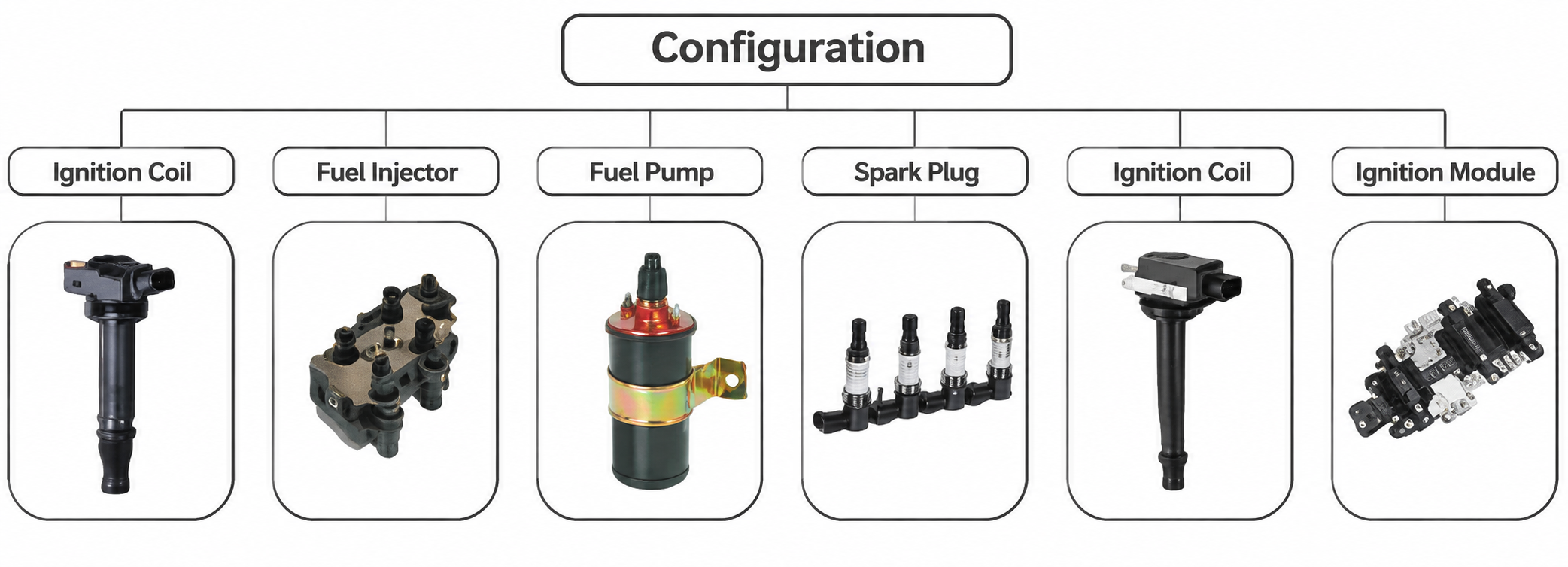
Ignition Coil Types
2. Causes of Ignition Coil Burnout
The main causes of ignition coil burnout are insulation aging and breakdown, or switching transistor failure.
A large spark plug gap causes a heavy load on the primary coil, high heat, and faster insulation aging. A small spark plug gap causes high secondary coil discharge current, high heat, and faster insulation aging. Aftermarket ignition coils may have a shorter service life due to poor insulation durability, high internal resistance and heat, or low-quality transistors.
If the coil keeps burning out and a replacement burns out again soon, what could be the reason? Here are some common causes:
-
Check the alternator first. If charging voltage is too high, the ignition coil is overloaded and more likely to burn out. However, if charging voltage is truly too high, body electrical components such as bulbs will also often fail. Of course, part quality issues cannot be ruled out, so it is best to measure charging voltage first.
-
Spark plug gap is too large; replace the spark plugs.
-
Poor gasoline quality; use higher-octane gasoline.
-
Incorrect cylinder compression ratio; adjust the compression ratio.
-
ECU program fault. Have a repair shop scan the vehicle with a diagnostic computer and clear the error codes. If the problem persists, there may be a drivetrain issue.
-
Unstable power supply voltage.
-
Abnormal resistance in the high-voltage wires; replace the high-voltage wires.
-
Short circuit in the primary circuit.
-
Primary current from the ignition controller is too high, causing the ignition coil to overheat.
-
Exposure to high temperature or a poor high-voltage waveform causing poor operation.
-
Poor operation of the igniter integrated circuit.
-
There is also a chance the coil itself is faulty. Try a new coil (ideally one with a long warranty).
An ignition coil is essentially a transformer, much like a transformer in a household appliance. When voltage varies within the specified range, the transformer will not burn out. Usually, a transformer burns out because it is overloaded. So when solving this problem, try to find the cause of the overload or component aging.
3. Diagnosing Ignition Coil Burnout
If the crankshaft position sensor (CKP) and camshaft position sensor (CMP) test normal but there is no high-voltage spark, it is usually an open circuit in the power supply wire of the ignition coil assembly.
When possible, use a professional test bench for analysis, or use the engine to make a judgment. Common faults mainly include: no output voltage (not working, misfire), low output voltage (shaking, stumbling), cracked insulation cover or housing causing leakage, etc.
Without professional equipment, simple judgments can be made using the following methods.
1. Visual Inspection
Inspect the appearance of the ignition coil. If there is abnormal substance leakage, or the insulation cover or housing is cracked, it should be replaced. These conditions are often related to abnormal power supply system issues, such as abnormal ECU control signals, damaged harness shorting to ground, etc. See the image below:
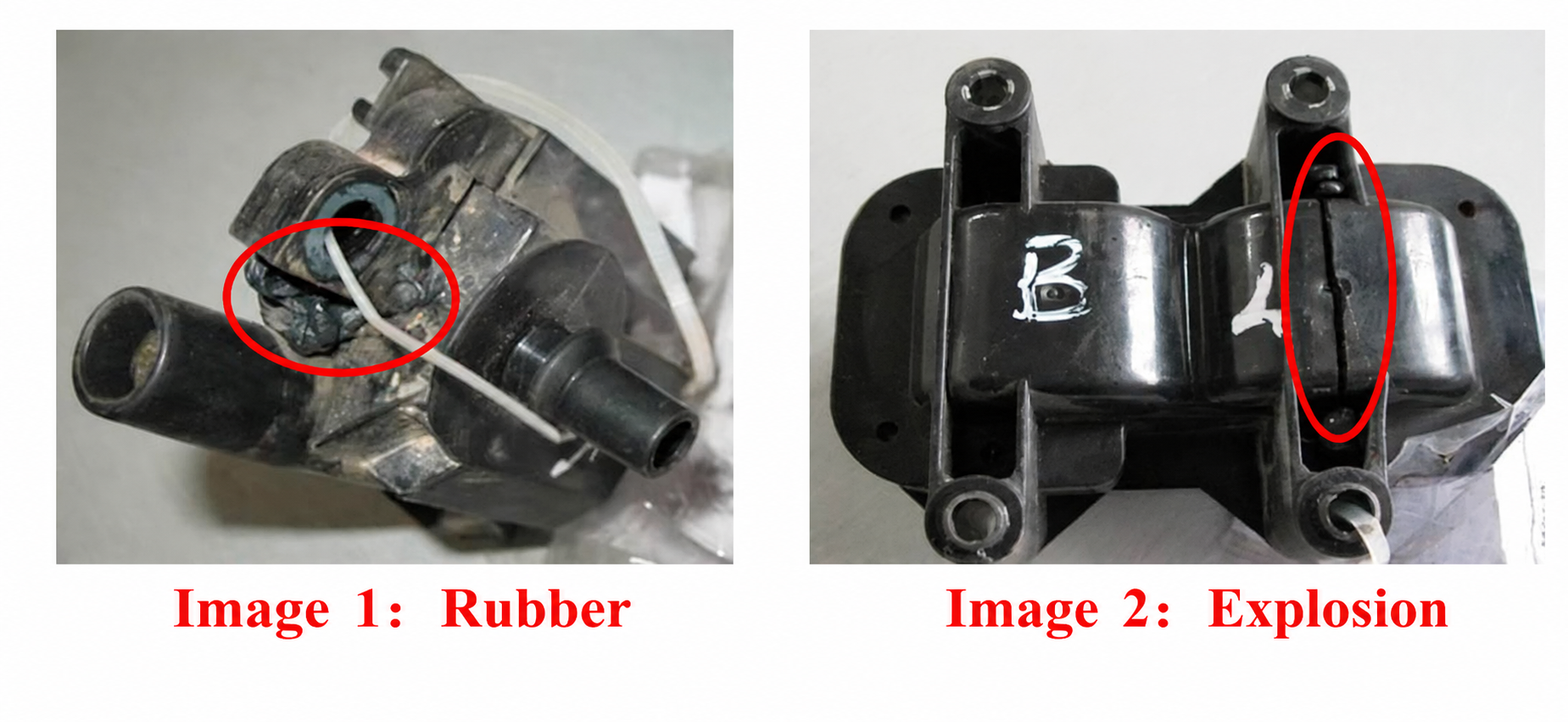
If there is suddenly no spark or weak spark while driving, use an infrared thermometer or touch to determine whether the ignition coil or ignition module has an internal short or open circuit. When diagnosing, you can also restart the engine. Whether it starts or not, measure the temperature of the ignition coil housing:
① Ignition coil overheated
If the surface temperature of the ignition coil is above 95°C, it indicates an internal short circuit in the ignition coil and it must be replaced.
② Ignition coil too cold
If the surface temperature of the ignition coil equals ambient temperature during starting, it indicates an internal open circuit and it must be replaced.
③ Ignition module overheated
If the ignition module temperature is above 100°C, it indicates an internal short circuit in the ignition module and it must be replaced.
④ Ignition module too cold
If the ignition module temperature equals ambient temperature during starting, it indicates an internal open circuit and it must be replaced.
2. High-Voltage Spark Test
The high-voltage spark test is mainly used when the ignition coil output voltage is low. Method:
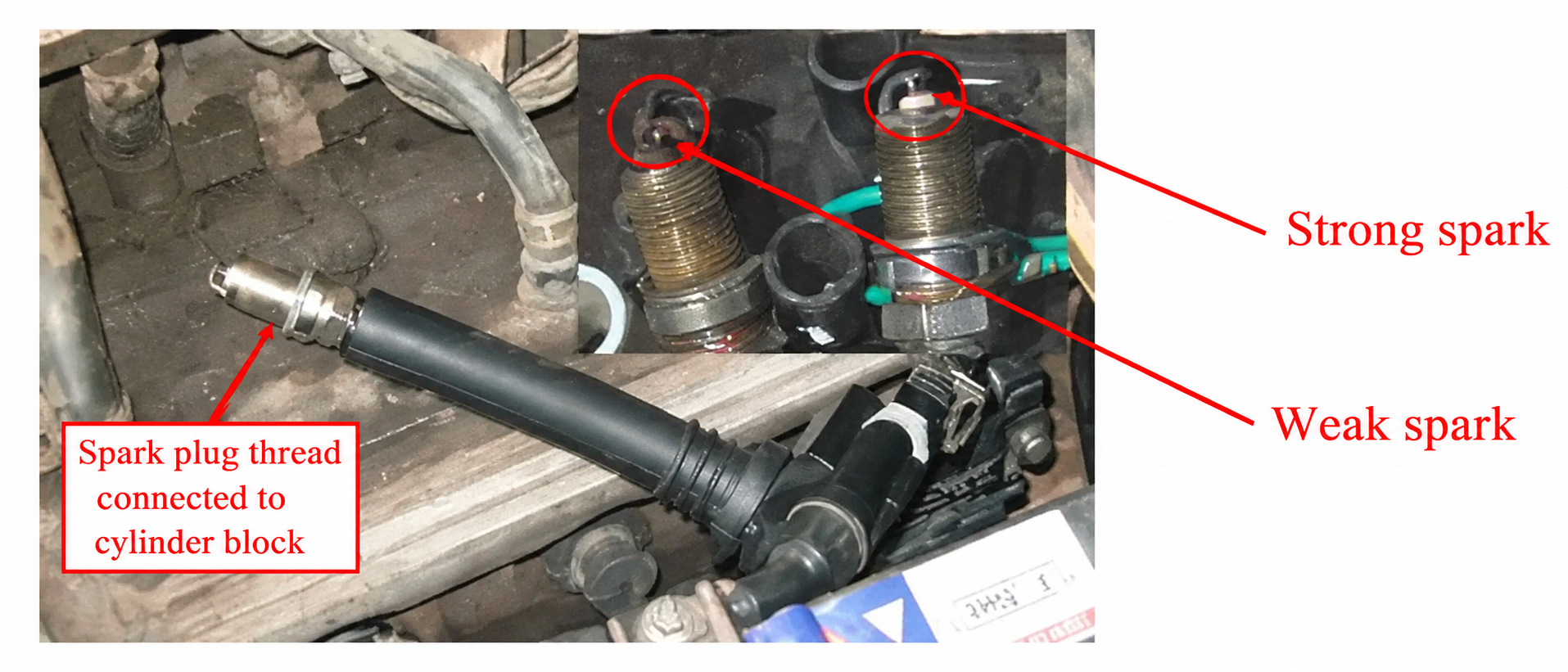
Pull out the high-voltage wire end from the spark plug, place the wire end 3–6 mm from the cylinder block, or connect a spare spark plug to the high-voltage wire harness (attach the threaded part of the spark plug to the cylinder block). Start the engine and check for spark. If the spark is weak or discontinuous, replace the ignition coil. Before performing the high-voltage spark test, first confirm that the control signal is normal. Also take proper insulation precautions. Touching the high-voltage wire directly with your hands can cause electric shock.
3. Substitution Method
The substitution method is mainly used when the ignition coil has no high-voltage output (not working). Method:
Use a coil of the same specification and known good performance to replace the possibly faulty coil and compare the results. If the fault disappears after replacement, the replaced coil may be damaged. When using this method, if the issue was caused by an unreliable plug connection corrected during reinstallation, or if a leaking or damaged point on the high-voltage wire or plug changes its discharge path due to reassembly, this may affect the judgment of the coil. In this case, install the coil on another vehicle to reproduce the fault and make a final confirmation.
Post time:Sep-25-2020
