
Executive Summary: If your engine feels sluggish, hesitates during acceleration, or runs with a rough idle, pulling out a blackened, sooty spark plug is a common sight. But does every fouled spark plug need immediate replacement? The short answer: Mild carbon buildup can self-clean under proper engine temperatures, but severe carbon fouling causes permanent electrical leakage and misfires—requiring immediate plug replacement and root-cause troubleshooting.
1. Mild vs. Severe Carbon: Can Fouled Plugs Be Saved?
Not all carbon buildup requires throwing away your spark plugs. Understanding the severity level determines whether your plugs can recover:
- Mild / Light Carbon (Self-Cleaning Zone): Under normal engine operation, spark plugs reach an operating temperature between 500°C and 800°C (930°F to 1,470°F). This is known as the spark plug self-cleaning temperature. Within this range, light carbon and soot deposits naturally burn off the ceramic insulator nose without manual intervention.
- Severe / Heavy Carbon (Permanent Failure): If carbon deposits form a thick, matte-black crust over the insulator and electrodes, the plug can no longer reach its self-cleaning threshold. Once this happens, the spark plug must be replaced immediately.
2. Why Severe Carbon Buildup Causes Engine Misfires
To understand why heavily fouled spark plugs fail, we have to look at the physics of electrical discharge:
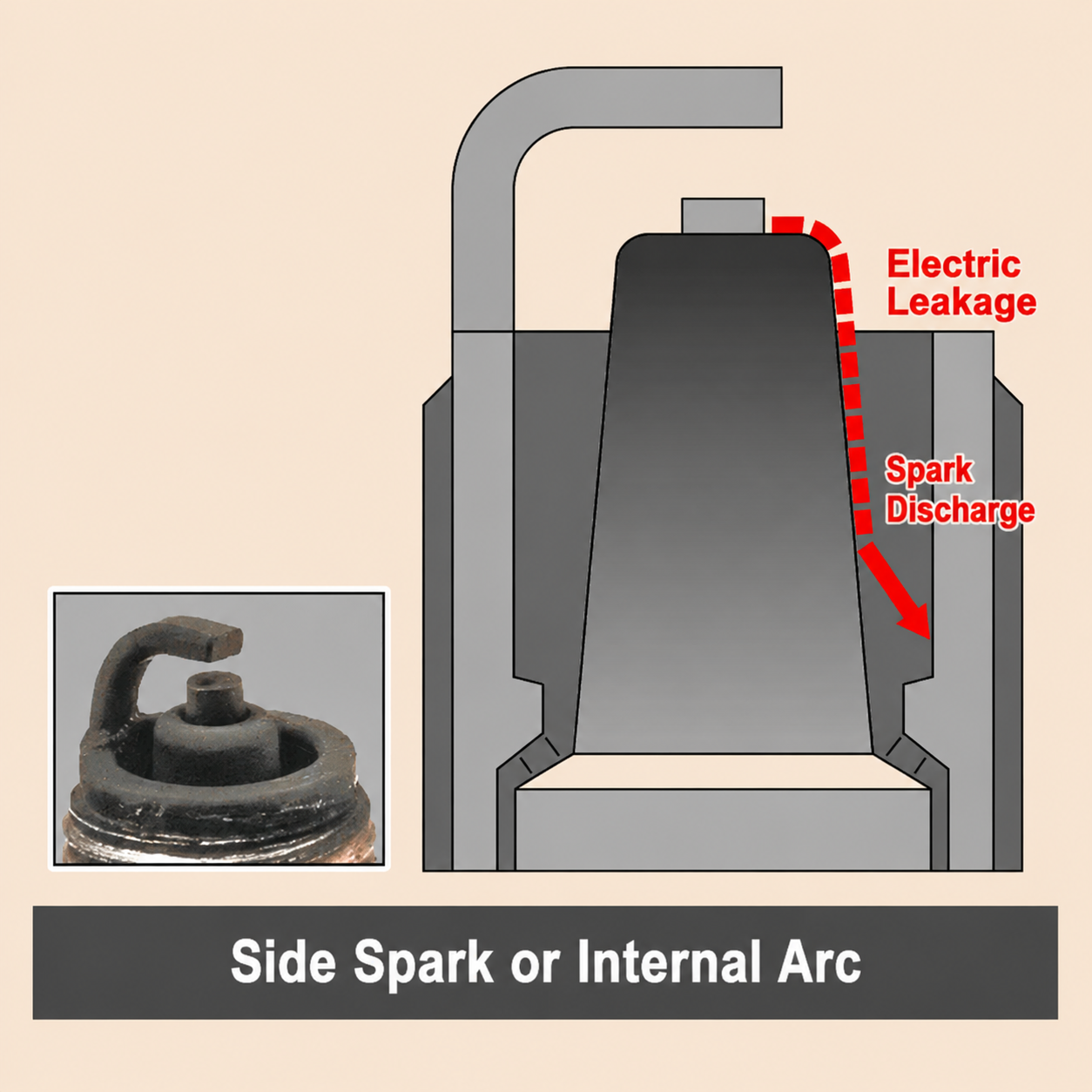
[Normal Plug] High Voltage ──> Center Electrode ──[Spark Across Gap]──> Ground[Fouled Plug] High Voltage ──> Carbon Layer (Conductive) ──[Current Leakage to Shell] ──> Misfire- Carbon Is Electrically Conductive: When thick soot coats the spark plug's ceramic insulator nose, it creates an unintended conductive bridge.
- Current Leakage (Spark Tracking): Instead of building enough voltage to jump across the electrode gap and ignite the fuel mixture, electrical current "bleeds off" along the carbon layer directly to the metal shell.
- Symptoms: This electrical leakage leads to a weak spark or total lack of spark, causing hard cold starts, rough idling, stumbling acceleration, and flashing Check Engine lights (P0300 misfire codes).
3. The 4 Root Causes of Carbon-Fouled Spark Plugs
Cleaning carbon off an engine or swapping plugs without fixing the underlying issue is only treating the symptom. Carbon forms when fuel and oxygen fail to achieve complete combustion.
Inspect the following 4 core areas:
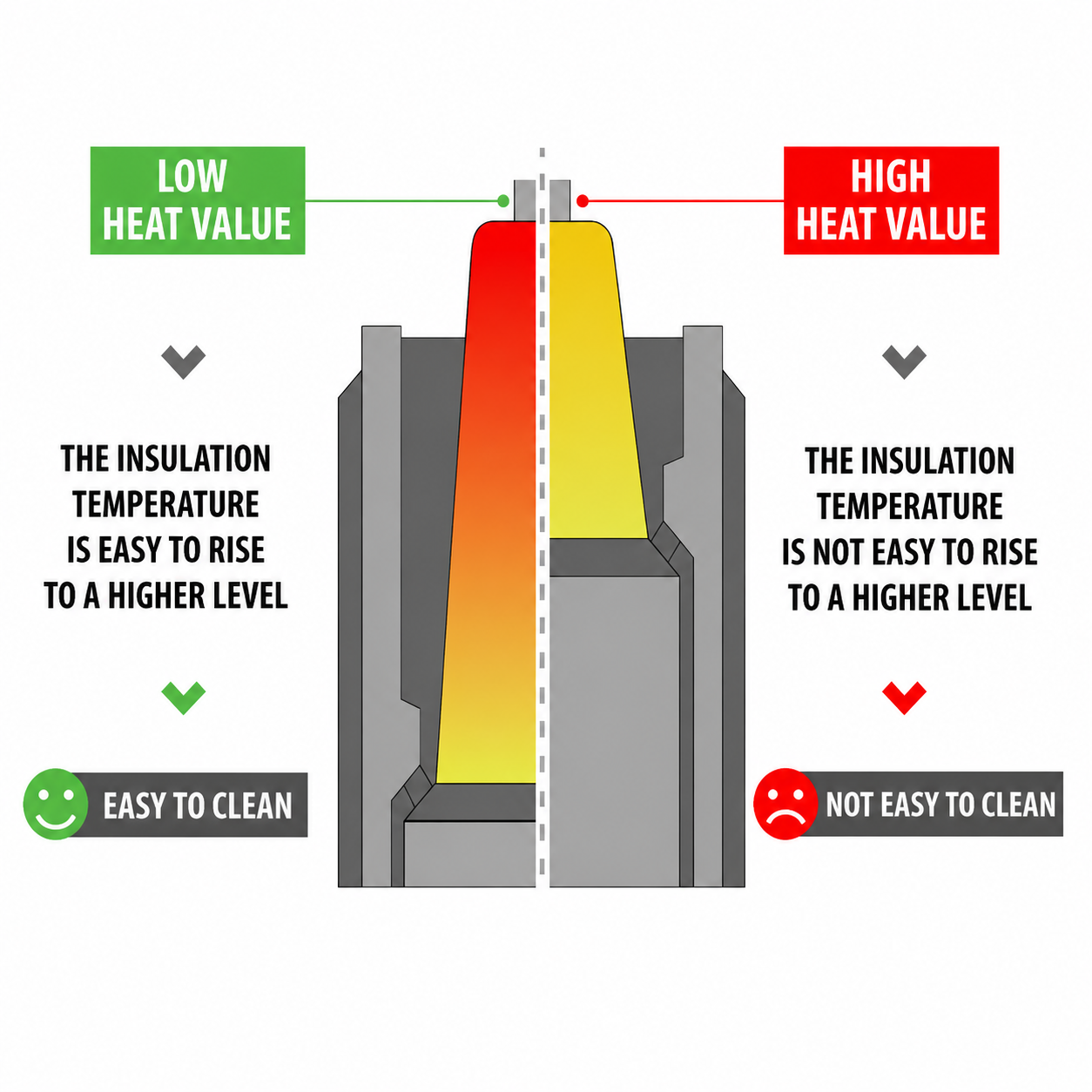
① Incorrect Spark Plug Heat Range (Too Cold)
If a replacement spark plug has a heat range that is too cold (meaning it dissipates heat too quickly into the cylinder head), the insulator nose will never reach the 500°C self-cleaning temperature, causing chronic carbon accumulation.
② Overly Rich Air-Fuel (A/F) Ratio
When too much fuel or too little air enters the combustion chamber, unburned hydrocarbons turn into carbon soot. Key culprits include:
- Leaking or clogged fuel injectors
- Defective Oxygen (O2) or Mass Airflow (MAF) sensors
- Faulty automated cold-start enrichment or improper carburetor tuning
③ Weak Ignition System Voltage
If the electrical system delivers insufficient voltage, spark energy remains weak, leading to incomplete flame propagation:
- Degraded high-tension ignition wires
- Failing ignition coils or coil-on-plug boots
- Low system voltage
④ Severe Low-Speed / Short-Trip Driving Conditions
Prolonged engine idling, continuous low-speed stop-and-go commuting, or frequent short trips where the engine never fully warms up will keep combustion temperatures low, accelerating soot buildup.
4. Step-by-Step Diagnostic Roadmap
When encountering carbon-fouled spark plugs during routine maintenance:
- Assess the Buildup: Determine if the soot is a light dusting (normal) or a thick, crusted coating (severe).
- Verify Part Numbers: Ensure the plug's heat range, thread reach, and electrode gap match factory OEM specifications.
- Investigate the Fuel & Ignition Systems: Check live OBD-II sensor data for short-term and long-term fuel trims (STFT/LTFT) to rule out rich air-fuel mixtures.
- Replace & Road-Test: Replace severely fouled plugs in full sets, clear any stored trouble codes, and take the vehicle on an extended test drive to establish proper operating temperatures.
5. Frequently Asked Questions (FAQ)
Post time:Sep-25-2020
